

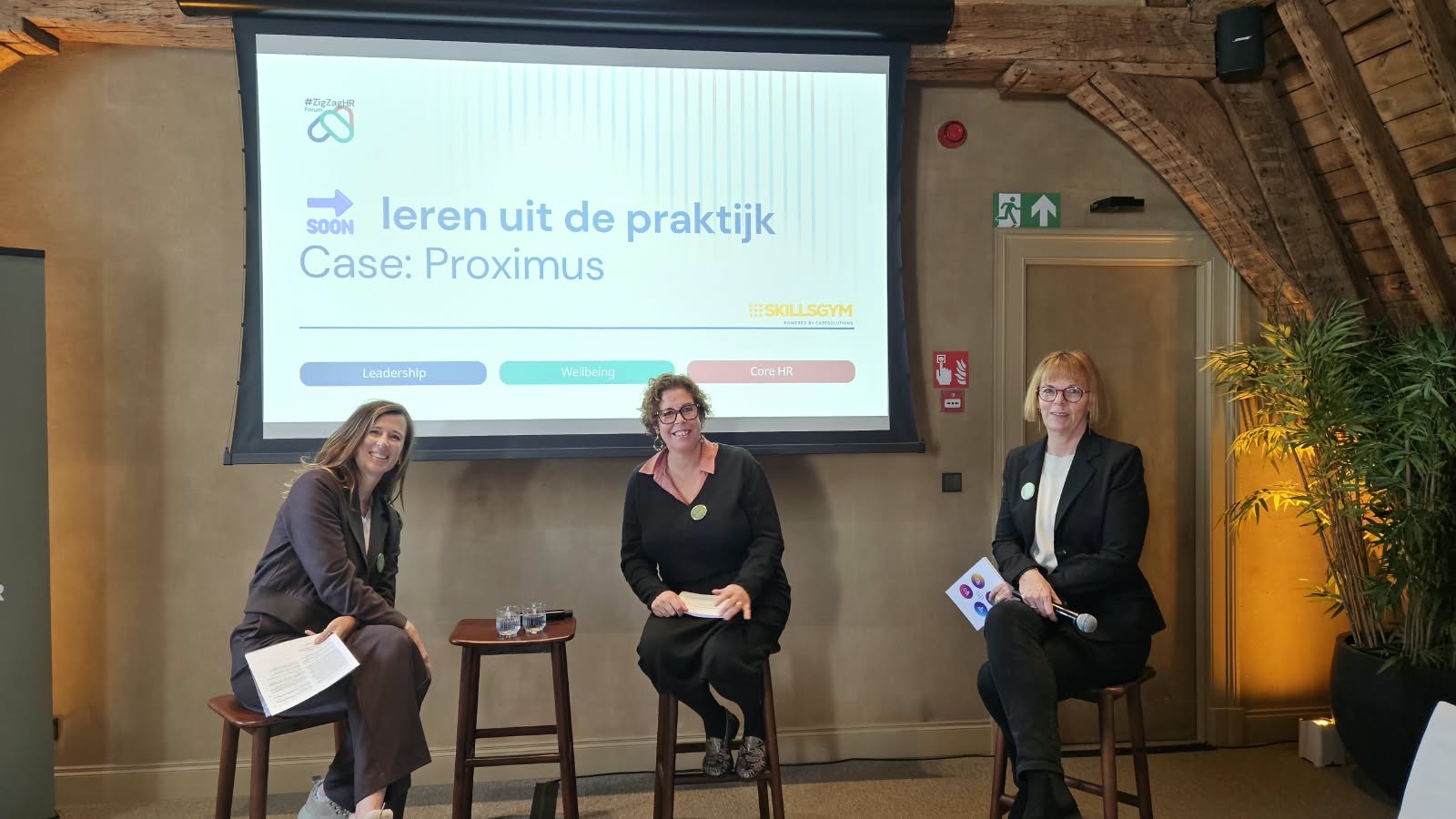
I've just stepped off the stage at the #ZigZagHR Forum, and one sentence is still ringing in my ears: expertise that stays in one person's head is worth little.
Most organizations manage expertise as something you have. You recruit it, retain it, certify it. But expertise only creates value when it creates impact — when someone else understands it, decides on it and acts on it.
That was the starting point of my conversation with Isabelle Rouzée and Véronique Dacier, learning partners at Proximus. Together we've been building PRO Track since 2016: a ten-month journey that helps Proximus experts turn their expertise into impact. It's now in its eighth generation. On stage, Isabelle and Véronique shared the whole story — what worked, what didn't, and what they'd do differently today. I want to write it down while it's fresh.
- 8 generations of experts since 2016
- 10 months, from kick-off to graduation
- ±400 colleagues on average per PRO Talk day
- 93% of alumni say their interpersonal skills improved
Why experts need their own journey
Proximus already had strong programs for people managers. But experts create impact differently. A manager gives direction to a team. An expert creates impact from their knowledge — usually without any formal authority.
Nobody ever doubted their technical expertise. The challenge was making it count: making complex matter clear, bringing different stakeholders along, influencing decisions, and staying calm when the message comes under pressure. So PRO Track trains exactly that — advanced communication, navigating change, and managing your energy and composure — always applied to the participant's own work.
And it matters even more today. Experts work across teams, squads and disciplines, with colleagues who don't speak their technical language. Meanwhile anyone can ask an AI assistant. What stays valuable is judging that answer and putting it in context. AI makes mistakes; you need an expert to spot them. Explaining how cybersecurity or data works is the easy part. Helping leadership understand what it means for their choices — that's the real work.
From "I want to explain my subject" to "what does my colleague need to understand my message and act on it?"
As Véronique put it: the program doesn't make anyone a better expert. Participants know as much afterwards as before. What changes is how they bring it across.
Three choices that make the difference
1. Experts apply themselves
Nobody is sent to PRO Track. Experts apply on the same internal platform Proximus uses for recruitment, with a profile and targeted questions. It feels more like applying for a job than signing up for a training — and the reflection on motivation starts before anyone is selected. Selection then runs in rounds: with the manager, at division level, then at business-unit level.
It wasn't always like this. In the first editions, managers nominated candidates, and some dropped out — they underestimated the investment, or it never felt like their own choice. Those who don't get a place now have a conversation with their manager, get a digital track, and can apply again. Managers don't decide who learns. But they decide a lot about what happens next: making time, giving space to practice, and allowing mistakes.
2. Learning by doing, together
Three skills: Delivering Your Message, Energy & Composure, and Navigating Change as an Expert. We started with six. That proved unrealistic. Less is more.
Participants bring their own cases. Between sessions they work in buddy pairs, deliberately matched with someone who learns differently, across business units and subsidiaries — so they practice with people who don't share their context, and build a network that lasts. Because we pull experts far out of their comfort zone, psychological safety starts at the kick-off: yoga and breathing exercises in the auditorium, barefoot. High challenge, high support.
3. Everything comes together on a real stage
The journey ends with the PRO Talk: a TED-style talk for real colleagues, in the room and on the livestream. Each participant chooses one idea that truly matters to their audience, and simplifies without losing substance. Nerve-racking — and a very proud moment. Across six PRO Talk days, around 400 colleagues joined per day, and every talk is filmed for the learning platform. One stage moment becomes a module colleagues can watch whenever the topic matters to them.
Graduation is a transition, not an end point
There's a formal graduation with senior leaders and the CEO, and a Credly badge to share on LinkedIn. Then the alumni community takes over: its own gatherings, speakers, and a steering group of five or six alumni who run a project each year — this year a discussion on sustainability and the telecom sector, with an external speaker and the CEO. Alumni host Welcome Days, support internal trainings, mentor young graduates and spar with new PRO participants.
Earlier editions used a 360° measurement before and after, and the progress was clear — not only in how participants saw themselves, but in what their environment observed. In the alumni survey, 93% say their interpersonal skills improved and 95% say the program met their initial goals.
What they'd do differently
Design who people learn with. A duo is fragile: when agendas clash, the exchange stops. Today they'd choose groups of four, with a deliberate mix.
Activate the manager. This year, for the first time, there was no information session for managers — a reminder that the manager's role isn't taken up automatically, even when everyone knows it.
Keep challenging the talks. Colleagues give 18 minutes to every PRO Talk, so every talk has to bring something.
Four things I'd say to every HR team
- Let people choose in. Self-application turns a program into something people want, not something they're sent to.
- Anchor it internally. Sponsorship from the top, involved managers and a dedicated learning team make the difference — not the external provider alone. I say that as the external provider.
- End with a real stage. A public moment gives practice a purpose and makes expertise visible.
- Build a community, not a course. Expertise is valuable when it flows through the organization.
One question to take home: think of one expert in your organization whose knowledge everybody needs and almost nobody hears. What stage could you give that person next month?
Thank you, Isabelle and Véronique, for eight generations of trust — and for being so honest about what you'd change.
— Sarah Cherif, founder of SkillsGym